
At Mission Auto KC in Merriam, KS, we proudly offer a range of BG products and services, designed to enhance vehicle performance and extend its lifespan. BG’s professional-grade automotive products are renowned for their top-notch quality and effectiveness. From fuel system cleaners to transmission fluids, our selection of BG products ensures your vehicle receives the utmost care, backed by BG’s reputation in automotive maintenance. Partnering with BG means our customers benefit from superior protection, improved performance, and the peace of mind that comes with using trusted automotive solutions. Bring your vehicle in today to experience the difference BG products can make.

BG Oil Engine
Treatment

BG Oil Engine
Treatment

BG Oil Engine
Treatment

BG Oil Engine
Treatment

BG Oil Engine
Treatment

Protecting you for every mile ahead
BG’s Automotive Maintenance Services Are Backed By The Free Lifetime BG Protection Plan.
At Mission Auto KC, we believe in delivering not only quality but also confidence in every service we provide. That’s why we’re proud to offer BG automotive maintenance services, a gold standard in the industry. BG’s state-of-the-art services range from fuel injection system cleaning to cooling system service, ensuring that every vital component of your vehicle operates at peak efficiency. But it doesn’t stop at just maintenance; when you opt for BG services at our facility, you also benefit from the BG Lifetime Protection Plan at no additional cost. This protection plan covers select components of your vehicle, promising that if they fail after receiving our BG service, repairs or replacements will be carried out at no charge to you. It’s not just a service—it’s a commitment to the longevity and reliability of your vehicle.
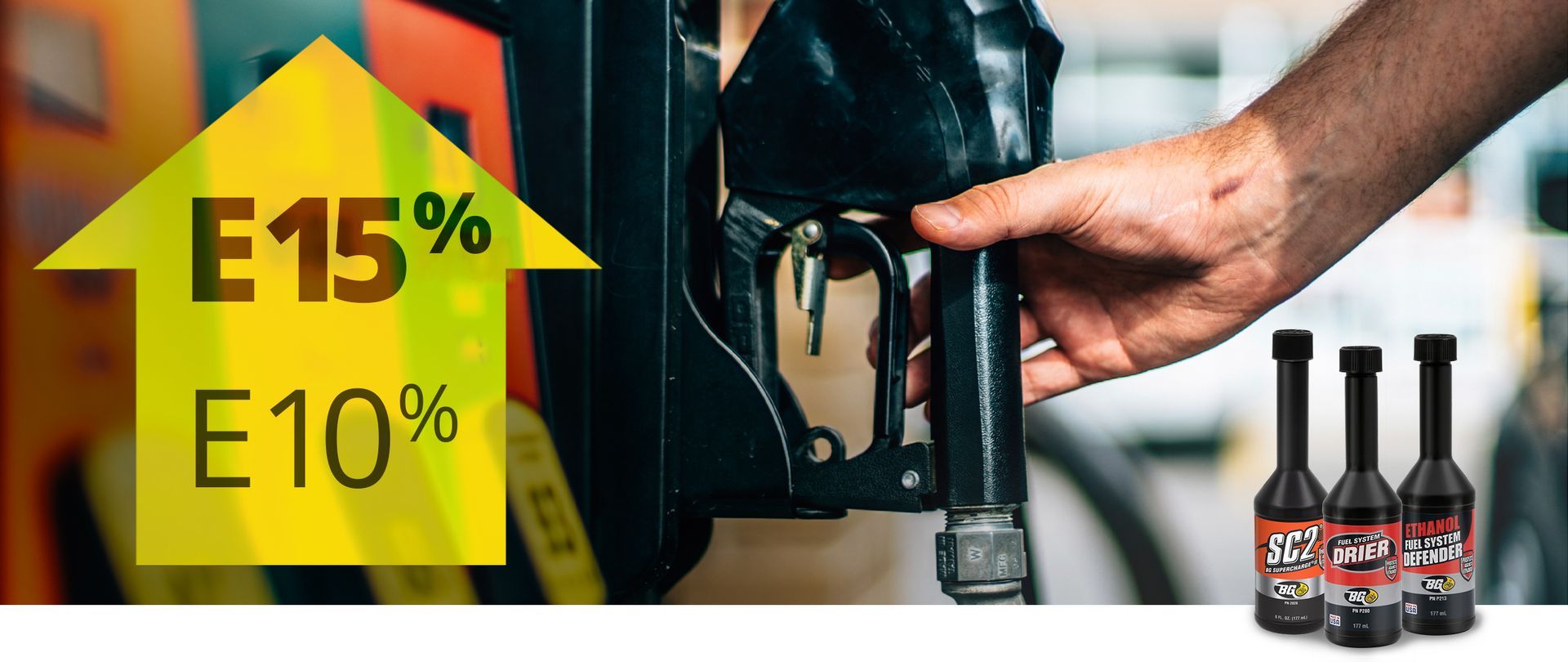
Adapting to an Increase in Ethanol
The recent Persian Gulf shipping disruption in the Strait of Hormuz has created a worldwide shortage of refined fuels. Because of this, the United States Environmental Protection Agency (U.S. EPA) is increasing the amount of ethyl-alcohol (i.e., ethanol) allowed in gasoline from 10% (E10) to 15% (E15).
This ethanol increase will help offset and reduce some of the refined gasoline volumes we rely on for transportation. As ethanol content increases and fuel characteristics continue to evolve, more vehicles will enter your bays with fuel that behaves differently.
While this blend is not new to most shops, it’s worth revisiting a few key facts about how this alcohol-based fuel affects today’s vehicles and re-evaluating current maintenance approaches to support more proactive, preventive strategies.
Ethanol Benefits
Increasing the ethanol percentage in gasoline enhances fuel combustion and reduces harmful emissions. Ethanol contains more oxygen than regular gasoline; more oxygen means better fuel ignition and better burning. Increased ethanol use is intended to help stabilize fuel prices at the pump. And since ethanol is already integrated into our fuel supply chain, its increase from 10% to 15% should not disrupt our distribution and delivery.
What does this mean for shops? Customers may not notice the change at the pump, but the long-term effects on vehicle performance and fuel system condition will become evident over time. Ask your customers which fuel they are using now to help them avoid potential issues down the road.
Ethanol Drawbacks
Some of the less-attractive attributes of ethanol relate to its mildly acidic nature. E15 accelerates the corrosion reaction in metals commonly found in fuel systems, especially iron, silver, and copper—primary components found in OEM fuel pumps and fuel delivery systems. As these metals oxidize, they form a passive oxidation layer that creates harmful deposits. As the fuel pressure regulator below shows, damage from both E10 and E15 can cause parts failure.*
To counteract this chemical attack on metal parts, specific corrosion inhibitors should be added to the E10 and E15 fuel at regular intervals.
In addition, E15 may create more fuel gums than E10, thus restricting fuel pump strainers. Over time, this can eventually ruin the fuel pump due to overheating.
As with all alcohol-blended fuels, water absorption through condensation increases dramatically when using E15 fuel. Gasoline with a higher alcohol content more readily attracts and holds water. At the very least, this may damage fuel injectors and high-pressure fuel systems. Since water turns to steam under high temperatures and pressures, mitigating this problem in E15 fuel is a priority.
This makes regular fuel system maintenance more critical than ever to prevent drivability issues and protect high-pressure systems.
Finally, E15 fuel destabilizes and separates more readily than E10 fuel. E15 has a tendency to separate into distinct layers of free water and “stale” gasoline when excess water contaminates the fuel. This causes the ethanol to bond with the water and drop out of the gasoline solution, creating a high-density alcohol-water layer at the bottom of the tank and leaving low-octane, irregular gasoline floating on top. The result can be severe engine damage or stalling. This condition is most often seen in storage and dispensing systems handling E10 and E15 fuels.